The study of Internet of Things Engineering lasts 4 years. According to the teaching plan, the curriculum system is divided into eight modules. The courses of different modules are linked to each other in chronological order.
Courses of the Mathematics, Computer and Natural Sciences Module are offered in semesters 1 to 3 to prepare students for subsequent courses.
Courses of Engineering Fundamentals Module are offered in semesters 1 to 4 to prepare students for engineering application courses.
Courses of the Engineering Applications Module are offered in semesters 3 to 6 so that students can acquire solid professional knowledge and be able to apply that knowledge effectively.
Courses of Professional Electives Module are offered in semesters 4 to 6, based on students' course interests and career development needs to meet personalized learning needs, further expand students' professional knowledge and improve students' knowledge application ability.
Courses of Foreign Languages Module are offered in semesters 1 to 4 to enable students to communicate professional issues in English and to develop intercultural communication skills required for career development.
Courses of General Education Module, offered in semesters 1 to 8, are designed to provide students with a broad knowledge base and interdisciplinary vision, develop critical thinking skills and the ability to apply knowledge comprehensively, so that they can better cope with complex social challenges and professional environments.
The Practical Courses Module is offered in semesters 1 to 8. The undergraduate graduation project (thesis) is carried out in the last semester, and the topics are mainly from the scientific research projects of the instructor and practical technical problems of the cooperative enterprises.
According to the cultivation plan, after eight semesters of study, students will receive 221 credits.
The curricular topology diagram is shown intheFigurebelow.
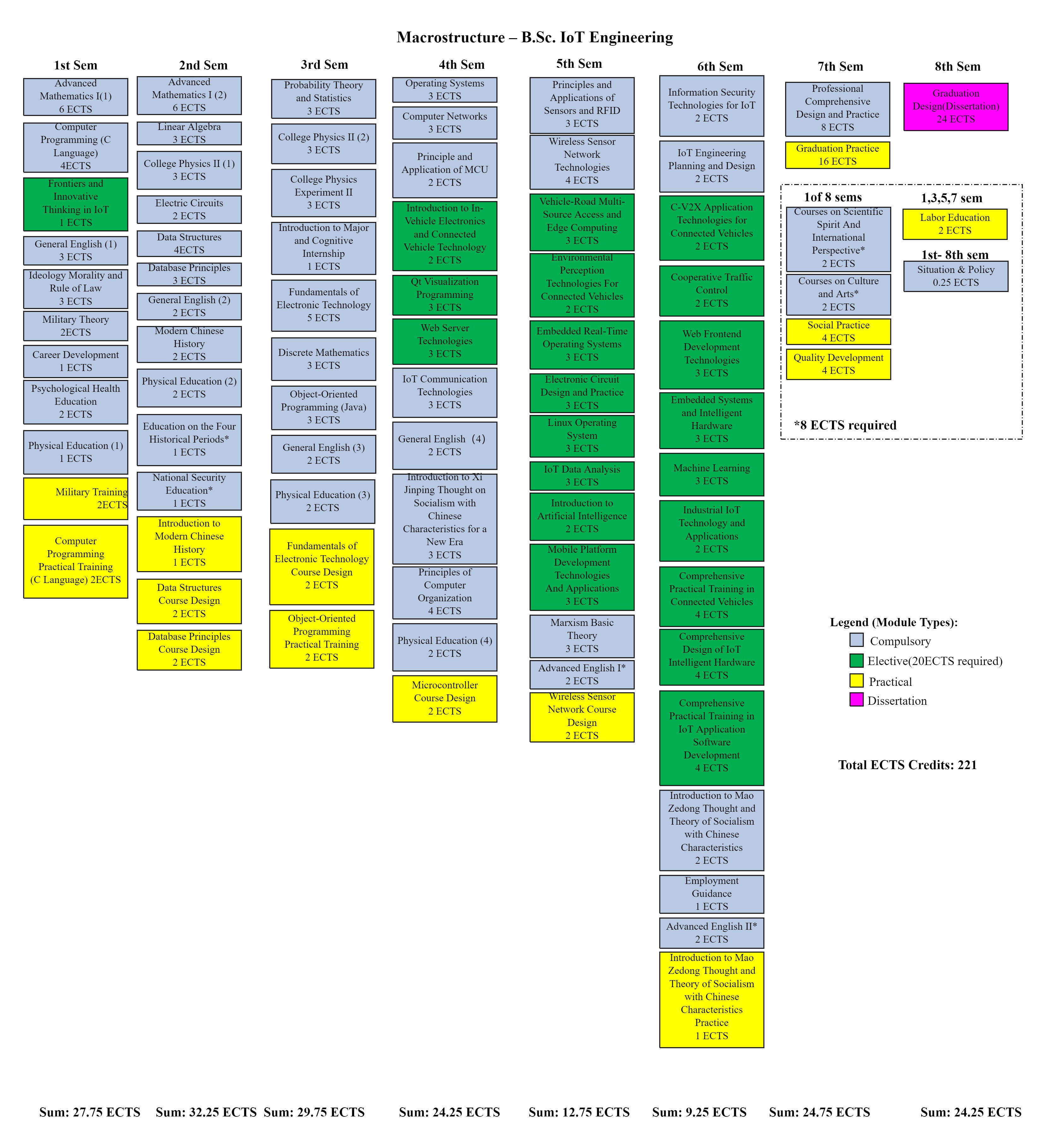
The curriculum system is divided into the following 8 modules:
Module 1: Mathematics, Computer and Natural Sciences
Learning Objectives: Master the knowledge of mathematics, computer and natural science to lay a solid foundation for subsequent courses. Be able to apply basic knowledge to analyze and solve practical problems.
Learning Outcomes: Able to use mathematics, computer science and natural science to understand and appropriately express technical problems; able to build basic models to analyze and solve practical problems in engineering; able to use mathematical methods to observe, analyze and solve practical engineering problems.
Relevant Courses: Advanced Mathematics I (1), Advanced Mathematics I (2), Linear Algebra, Probability and Statistics, University Physics II (1), University Physics II (2), University Physics Experiment II (1), University Physics Experiment II (2), Computer Programming (C language), Data Structure.
Module 2: EngineeringFundamentals
Learning Objectives: Master the basic knowledge and lay a solid foundation for the study of professional courses.
Learning Outcomes: Master the basic knowledge of circuit, electronic technology, programming, Internet of Things communication; the ability to analyze and solve practical engineering problems.
Relevant Courses: Circuit, Basic Electronic Technology, Discrete Mathematics, Operating System, Computer Organization Principles, Database Principle, Internet Of Things Communication Technology, Professional Guidance And Cognitive Practice.
Module 3: EngineeringApplications
Learning Objectives: Master solid professional knowledge and have strong ability to apply professional knowledge.
Learning Outcomes:Master the general methods and skills needed to solve practical engineering problems; according to the characteristics of the Internet of Things engineering field, can continuously analyze, summarize, check and summarize the phenomena in the project.
Relevant Courses: Computer Network, Object-Oriented Programming (Java), Sensor And Rfid Principle And Application, Internet Of Things Information Security Technology, Wireless Sensor Network Technology, Internet Of Things Engineering Planning And Design, Microcontroller Principle And Application Module.
Module 4: ProfessionalElectives
Learning Objectives: According to students'course interests and career development needs, meet personalized learning needs, further expand students' professional knowledge, improve students' knowledge application level.
Learning Outcomes:Master cutting-edge knowledge and skills in the field of Internet of Things engineering, and be able to comprehensively evaluate technical solutions.
Relevant Courses: Advanced Topics in the Internet of Things and Innovative Thinking, Introduction to Vehicle Electronics and Connected Vehicle Technology, Multi-source Access and Edge Computing for Vehicles and Roads, Vehicle-to-Everything (C-V2X) Application Technology, Vehicle-to-Everything (C-V2X) Application Technology, Collaborative Traffic Control, Qt Visualization Programming, Embedded Real-time Operating Systems, Electronic Circuit Design and Practice, Embedded Systems and Smart Hardware, Linux Operating System, Web Server Technology, Internet of Things Data Analysis, Web Front-end Development Technology, Introduction to Artificial Intelligence, Machine Learning, Mobile Platform Development Technology and Applications, Industrial Internet of Things Technology and Applications.
Module 5: ForeignLanguages
Learning Objectives:To develop intercultural communication skills and international cooperation skills.
Learning Outcomes:Through the knowledge required by college English; able to find and read professional English literature, and be able to communicate professional issues in English; have cross-cultural communication skills needed for career development.
Relevant Courses: General English (1), General English (2), General English (3), General English (4).
Module 6: General Education
Learning Objectives:to understand China's social model and social norms; to have good quality, team spirit and humanistic feelings; to achieve all-round development in morality, intelligence, physical fitness, beauty and labor.
Learning Outcomes: Master the knowledge of modern Chinese history, the basic principles of Marxism, humanistic spirit, physical education, and military training; Understand social phenomena; Pay attention to and adapt to social development; Communicate and collaborate effectively with others; Foster a spirit of teamwork; Promote physical and mental health and personal growth; Develop good character and psychological qualities; Cultivate a correct outlook on life, values, morals, and law; Possess humanistic literacy and a sense of social responsibility.
Relevant Courses: Current Situation and Policies, Ideological and Moral Education and Rule of Law, Outline of Modern and Contemporary Chinese History, Introduction to Xi Jinping's Thought on Socialism with Chinese Characteristics for a New Era, Basic Principles of Marxism, Mao Zedong Thought and the Theoretical System of Socialism with Chinese Characteristics, Military Theory, Career Planning, Mental Health Education, Employment Guidance, Physical Education (1), Physical Education (2), Physical Education (3), Physical Education (4), Military Training, Practice of Modern and Contemporary Chinese History, Practice of Mao Zedong Thought and the Theoretical System of Socialism with Chinese Characteristics.
Module 7: Practical Courses
Learning Objectives:To enable students to consolidate theoretical knowledge, enhance their understanding of applied knowledge, and be able to analyze and evaluate complex problems; design problems and propose solutions.
Learning Outcomes:Master the ability to analyze and solve practical problems in IoT engineering; Be capable of identifying, analyzing, and addressing key issues in IoT and related projects, and provide solutions while understanding the various factors that influence technical solutions. Apply engineering knowledge to analyze and evaluate problems, recognizing their limitations; Innovate in design to find valuable solutions.
Relevant Courses: Computer Programming Practice (C Language), Data Structure Course Design, Database Principle Course Design, Electronic Technology Basic Course Design, Microcontroller Course Design, Object-Oriented Programming Practice, Wireless Sensor Network System Design, Professional Comprehensive Design And Practice, Graduation Internship,Graduation Design (Thesis).
Module 8:Graduation Dissertation(Design)
Learning Objectives:Be able to propose solutions based on the analysis of practical problems and complete practical topics.
Learning Outcomes:Be able to complete the writing of a bachelor's degree thesis under the guidance of a tutor and pass the graduation defense.
Relevant Courses:Graduation Design (Thesis).

