The Computer Science and Technology is a four-year programme, with each year divided into a fall semester and a spring semester, each lasting twenty weeks. Sixteen weeks are dedicated to courses and activities, and four weeks are for review and examinations.
The Mathematics and Natural Sciences module is offered in the first three semesters, preparing students for subsequent courses.
The Engineering Foundations module is offered in the first four semesters, preparing students for engineering applications courses.
The Engineering Applications module is offered in the third to sixth semesters, helping students acquire solid professional knowledge and apply it effectively.
The Elective Professional Module is primarily offered in the fifth and sixth semesters, catering to students' individual learning needs based on their interests and career development require-ments, further expanding their professional knowledge, and enhancing their ability to apply it. Students are required to complete 28 credits in this module.
The Foreign Language Courses Module is offered in the first, second, fifth, and sixth semesters, with the fifth and sixth semesters being electives. It aims to help students communicate profes-sionally in English and develop the cross-cultural communication skills needed for career devel-opment.
The General Education Module is offered from semesters 1 to 8, aiming to provide students with a broad knowledge base and interdisciplinary perspective, cultivate critical thinking skills and the ability to comprehensively apply knowledge, enabling them to better cope with complex social challenges and professional environments. Students are required to take 8 credits in this module.
The practical course module is also offered from semesters 1 to 8. The undergraduate Graduation Design(Thesis) is conducted in the final semester, with topics primarily derived from the research projects of the supervising professors and practical technical problems from partner companies.
According to the curriculum plan, students will earn 220 credits after eight semesters of study. The course topology is shown in Figure below.
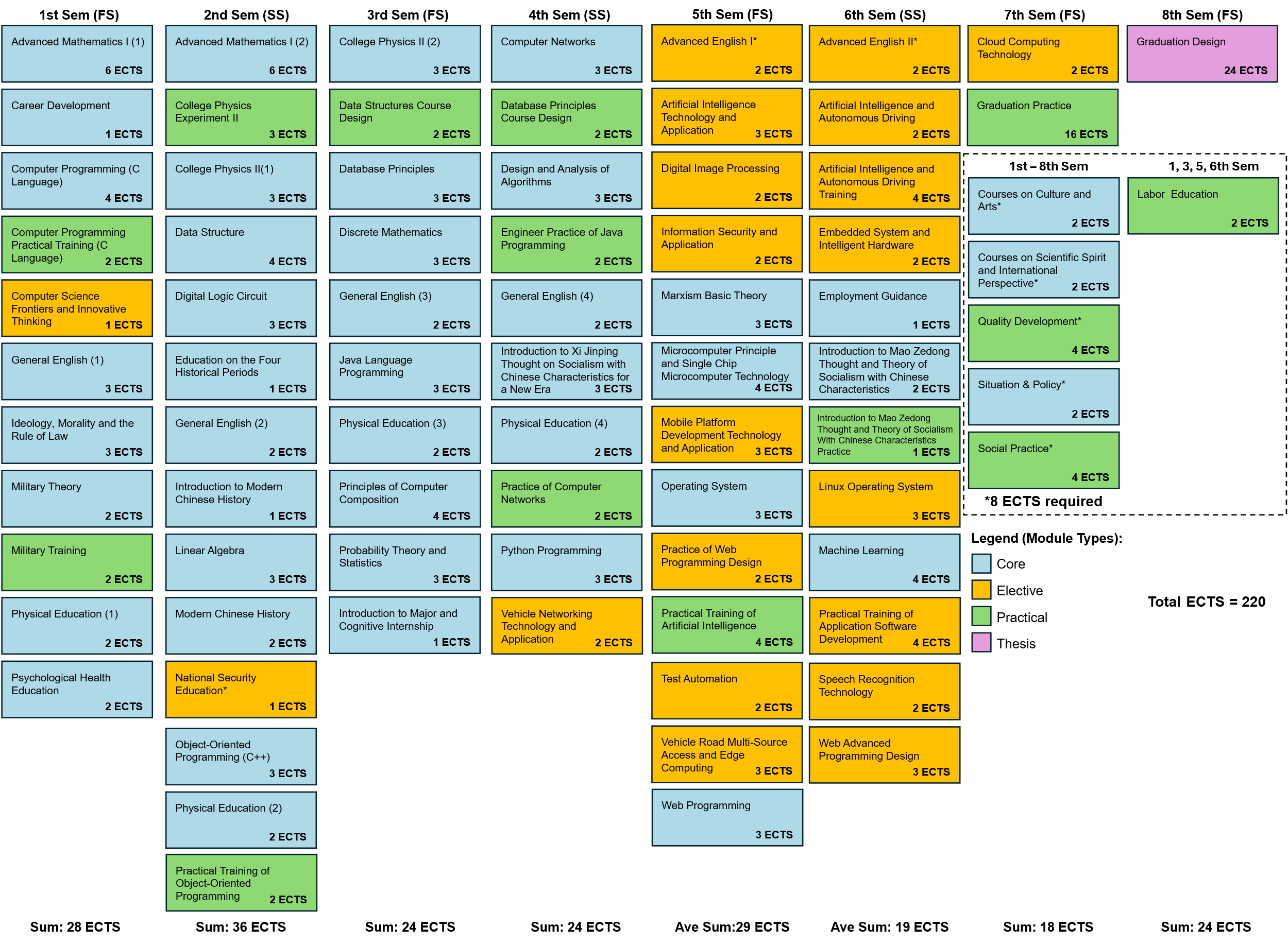
The curriculum system is divided into the following 8 modules:
Module 1: Mathematics and Natural Sciences
Learning Objectives: To master the fundamental knowledge of mathematics and natural sciences, providing support for analyzing and solving complex engineering problems.
Learning Outcomes: Be able to understand and express technical problems based on mathematical and natural science knowledge, establish models to analyze engineering phenomena, and solve real-world problems using experimental and computational methods.
Relevant Courses: Advanced Mathematics I (1), Advanced Mathematics I (2), Linear Algebra, Probability and Statistics, College Physics II (1), College Physics II (2), College Physics Experiment II.
Module 2: Engineering Foundations
Learning Objectives: To acquire the fundamental theories and methods in computer science and technology, laying a solid foundation for learning professional courses.
Learning Outcomes: Be able to proficiently use programming languages for software development, understand the fundamental principles of hardware and logic design, and possess data modelling and analysis capabilities.
Relevant Courses: Introduction to Major and Cognitive Internship, Computer Programming (C Language), Digital Logic Circuit, Data Structure, Discrete Mathematics, Object-Oriented Programming (C++), Database Principles, Operating System, Principles of Computer Composition.
Module 3: Engineering Application
Learning Objectives: To master core technologies in computing and solve complex engineering application problems.
Learning Outcomes: Be able to leverage computer networks, operating systems, database systems, and other related professional knowledge to design and implement applications that meet specific requirements. Familiar with algorithmoptimisationand system architecture, with strong analytical and research capabilities.
Relevant Courses: Computer Networks, Python Programming, JavaLanguage Programming, Web Programming, Machine Learning, Microcomputer Principle and Single Chip Microcomputer Technology, Design and Analysis of Algorithms.
Module 4: Elective Professional Courses
Learning Objectives: To gain knowledge of cutting-edge technologies in artificial intelligence and embedded systems, enhancing practical and innovative capabilities.
Learning Outcomes: Be able to develop and apply AI algorithms, design embedded systems, possess hands-on practice and entrepreneurial innovation abilities, and solve complex engineering problems.
Relevant Courses: Computer Science Frontiers and Innovative Thinking, Web Advanced Programming Design, Cloud Computing Technology, Artificial Intelligence Technology and Application, Information Security and Application, Linux Operating System, Digital Image Processing, Speech Recognition Technology, Mobile Platform Development Technology and Application, Embedded System and Intelligent Hardware, Test Automation, Artificial Intelligence and Autonomous Driving, Vehicle Road Multi-Source Access and Edge Computing, Vehicle Networking Technology and Application,PracticalTraining of Artificial Intelligence,PracticalTraining of Application Software Development, Artificial Intelligence and Autonomous Driving Training.
Module 5: Foreign Language Courses
Learning objective: Possess cross-cultural communication skills and deep insights, as well as international cooperation capabilities.
Learning outcomes: Knowledge required to pass College English Test Band 4 (CET-4) and Band 6 (CET-6). Able to find and read professional English literature, and able to communicate professional problems in English. Have cross-cultural communication skills required for career development.
Related courses: General English Course (1), General English Course (2), General English Course (3), General English Course (4).
Module 6: General Courses
Learning objective: Understand China's social models and norms, possess good character, team spirit, and a sense of humanity, and achieve well-rounded development in moral,intellectual, physical, aesthetic, andlaboureducation.
Learning outcomes: Master knowledge of modern and contemporary Chinese history, humanistic spirit, and physical education; understand social phenomena, demonstrate awareness of and adaptability to social development, and possess team spirit with the ability to communicate and collaborate effectively with others. Have a sound personality and psychological resilience, promoting physical and mental well-being and self-improvement. Hold a correct outlook on life, values, ethics, and the law, while possessing humanistic literacy and a strong sense of social responsibility.
Related courses: Situation & Policy, Ideology, Morality and the Rule of Law, Modern Chinese History, Introduction to Xi Jinping Thought on Socialism with Chinese Characteristics for a New Era, Marxism Basic Theory, Introduction to Mao Zedong Thought and Theory of Socialism with Chinese Characteristics, Military Theory, Career Development, Employment Guidance, Psychological Health Education, Physical Education (1), Physical Education (2), Physical Education (3), Physical Education (4), Courses on Scientific Spirit and International Perspective, Courses on Culture and Arts, Education on the Four Historical Periods, National Security Education, Advanced English I, Advanced English II.
Module 7: Practice Courses
Learning objective: To enable students to consolidate theoretical knowledge, enhance their understanding of applied knowledge, and be able to analyze and evaluate complex engineering problems and propose solutions.
Learning outcomes: Be able to write, debug, and optimize code for various applications. Be able to apply computational thinking to solve complex engineering problems, design efficient algorithms and data structures to address these challenges while understanding their limitations. Be able to innovate design and find valuable solutions.
Related courses: Military Training, Introduction to Modern Chinese History, Introduction to Mao Zedong Thought and Theory of Socialism With Chinese Characteristics Practice, Computer Programming Practical Training (C Language), Data Structures Course Design, Practical Training of Object-Oriented Programming, Database Principles Course Design, Practice of Web Programming Design, Engineer Practice of Java Programming, Practice of Computer Networks, Graduation Practice, Social Practice, Labor Education, Quality Development.
Module 8: Bachelor’s Degree Thesis
Learning objective: Be able to propose solutions based on analyzing practical problems and complete practical topics.
Learning outcomes: Be able to complete the writing of the bachelor’s degree thesis with the help of the instructor and pass the graduation defense.
Related courses: Graduation Design.

